
Asheboro Previous Residents Sources
An Asheboro address history has several layers. An Asheboro current parcel card supplies a starting legal description and deed reference. The Asheboro Register of Deeds ties names to recorded transactions. Asheboro Miller directory street sections and census schedules add dated household clues, while Sanborn maps help place a structure in time. Use the Asheboro source that fits the era, and do not treat a property owner, a directory entry, and a census household as interchangeable.
| Source | Years It Covers | Where Held | What It Shows |
|---|---|---|---|
| Asheboro/Randolph PWA parcel card | Current tax system; changes daily | Randolph Property Search | Owner, situs, mailing, REID/PIN, deed and sales tabs |
| Asheboro Register of Deeds real-estate index | 1986 to current online | County portal and office | Named parties, book/page, instrument, and legal chain |
| Asheboro historic deed books | Books 1071–1172 | Register of Deeds historical path | Older index and image bridge |
| Asheboro Miller directories | Selected 1937/38–1962 runs | DigitalNC and Randolph Room | Address sections and dated household listings |
| Asheboro federal census trail | 1950 and earlier released schedules | Archive and library databases | Household context at census time |
| Asheboro Sanborn maps | 1910, 1922, 1931, and 1950 | Randolph Room microfilm | Building footprint, use, and street context |
For recent Asheboro previous residents, begin with the parcel and deed chain. For an older Asheboro house history, use the recorded legal description to connect an Asheboro street address to a lot or plat, then test the available directory and census years. A missing Asheboro result may be a gap in coverage, not proof that no one lived there.
Asheboro Parcel Starting Point
The Randolph Property Search accepts Asheboro Owner/Business Name, Location Address, REID, and PIN. Asheboro address searching uses street number and street name without a street type or direction. The resulting Asheboro parcel summary can show a current owner, location address, owner mailing address, property description, acreage, deed date and book/page, sales data, plat reference, and map links. The tax system changes daily and should be treated as an Asheboro current starting point rather than a history of occupancy.
Separate Asheboro situs from mailing address as soon as a result opens. Situs identifies the Asheboro parcel location; a mailing address is where tax correspondence goes. It may be a post-office box, an office, an estate representative, or another tax destination. Record Asheboro REID/PIN, legal description, and book/page before following names, because those parcel details are much more stable than a single address label.
Asheboro 1986 Deed Bridge
The Randolph real-estate records page says the online Asheboro index and images begin January 1, 1986. It separately identifies historical Books 1071–1172 and Asheboro plat books from Book 1 to current. Name, Book/Page, Subdivision, and Date Range are the documented Asheboro search modes. Date and document-type limits can narrow a query, while Advanced Search with a contains match helps with name variations.
For Asheboro names in the 1986–93 period, try the county's documented abbreviations such as Chas, Robt, Thos, and Wm. An Asheboro book/page ending in E in GIS is a Clerk of Court matter, not a Register of Deeds instrument. When the Asheboro web index stops, use the historical books, office indexes, microfilm, or a request to the Register of Deeds instead of guessing that the address has no earlier chain.
The Register of Deeds recording page supplies the source image that follows.
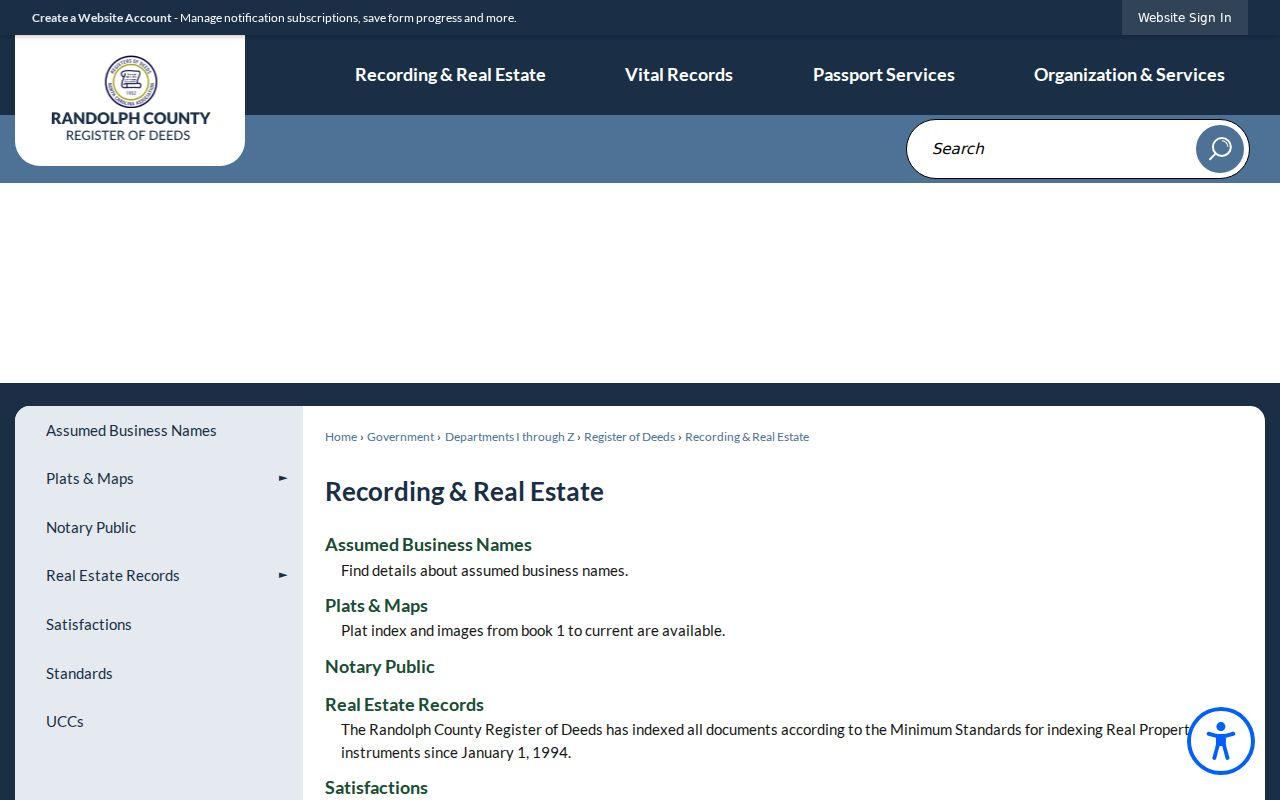
The index is a way into the recorded chain. The deed, attached plat, and clerk file where applicable control the underlying record.
Trace Asheboro Previous Residents
Work backward from an Asheboro documented transaction, not from a name alone. The current Asheboro parcel card supplies the legal description and current deed book/page. In the Register of Deeds index, the current buyer is the grantee on the purchase deed. That Asheboro instrument names the seller or grantor and gives the description to use when searching for the seller's own purchase. Match subdivision, lot, plat, acreage, dates, and neighboring descriptions to prevent a same-name error.
- Open the parcel card and save the REID/PIN, legal description, current deed book/page, and the distinction between situs and mailing data.
- Search the current grantee or book/page in the deed index, then read the recorded deed for the grantor and property description.
- Search that grantor as a prior grantee, using the lot, subdivision, plat, date, or book/page to keep the parcel chain intact.
- Repeat each transfer backward, recording the instrument type and every legal party without turning a trustee, estate, or organization into an individual occupant.
- At the online cutoff, move to Books 1071–1172, plats, office indexes, or the Register of Deeds for the older link.
- Grantor / grantee
- The grantor transfers an interest in a deed; the grantee receives that recorded interest.
- Chain of title
- The sequence of recorded transfers used to trace a parcel's ownership history.
- Legal description
- The lot, subdivision, plat, metes-and-bounds, or other deed language that identifies property beyond a changing street address.
Asheboro Plats and Old Names
Plats are especially useful when a street label changes or a house number fails to appear in an older source. Randolph's plat index and images extend from Book 1 to current, and a legal description can bridge a modern parcel to a lot or subdivision. County GIS is compiled from deeds, plats, and other public records, but it expressly is not the legal document. Confirm a mapped detail against the recorded instrument.
Asheboro history adds a local search trap. Main Street appeared as McCulloh Street in older Asheboro deeds, and the town name appears as Asheborough, Ashboro, and Asheboro. Postal standardization to Asheboro occurred on January 10, 1923. Test those Asheboro spellings and the old street label in deeds, directory scans, and newspaper OCR. A complete citywide renumbering list was not located, so lot and plat matching remains the safer bridge.
Asheboro Past Resident Census Pairing
Recorded owners are only one part of a house history. Miller's selected Asheboro/Randolph directories offer alphabetical listings and street sections for 1937/38, 1939/40, 1947/48, 1949/50, 1951/52, 1955/56, 1960, and 1962. The 1941/42 volume is confirmed at the local-history room, even though a digitized image was not located. The volumes are selected runs, not an unbroken annual series. The Asheboro city directory collections page describes where those volumes can be consulted.
- Locate the address in a street section for one available directory year and note the exact street spelling and house number.
- Check the alphabetical listing for the same period, then preserve the edition's abbreviations and household wording instead of expanding them by guesswork.
- Pair 1937/38 or 1939/40 with the 1940 census, and pair 1950/51/52 directory evidence with the released 1950 census.
- Compare the address with the next available directory, allowing for old street names, changed numbering, and a possible gap between volumes.
A directory or census entry is time-stamped household evidence, not a deed or proof of continuous presence. The Historic Preservation Office survey confirms the early local-library directory holdings used in this trail.
Asheboro Obituary Trail
The Asheboro Randolph Room's Courier-Tribune index turns a name into a paper date, page, and death-date lead. It is an index, not the full notice. Use the date and page to request the relevant microfilm or scan, then compare the notice with an Asheboro deed or estate docket when the family-history question is relevant. The 1936–39 index is one documented route for an older address trail.
The Courier-Tribune 1936–39 index is represented by this image.
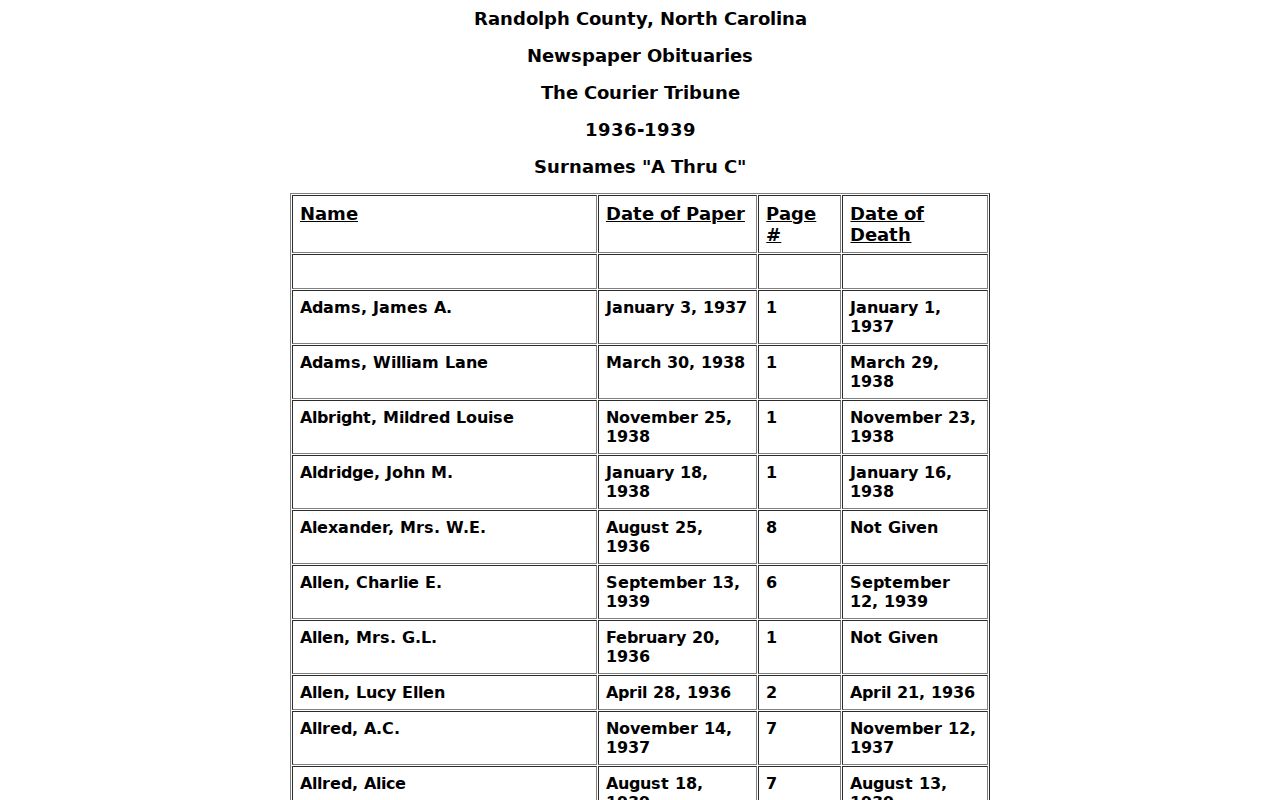
That index entry supplies a traceable newspaper reference without replacing the underlying notice or the Clerk's estate file.
The Courier-Tribune 1946–49 index provides another documented sample run.
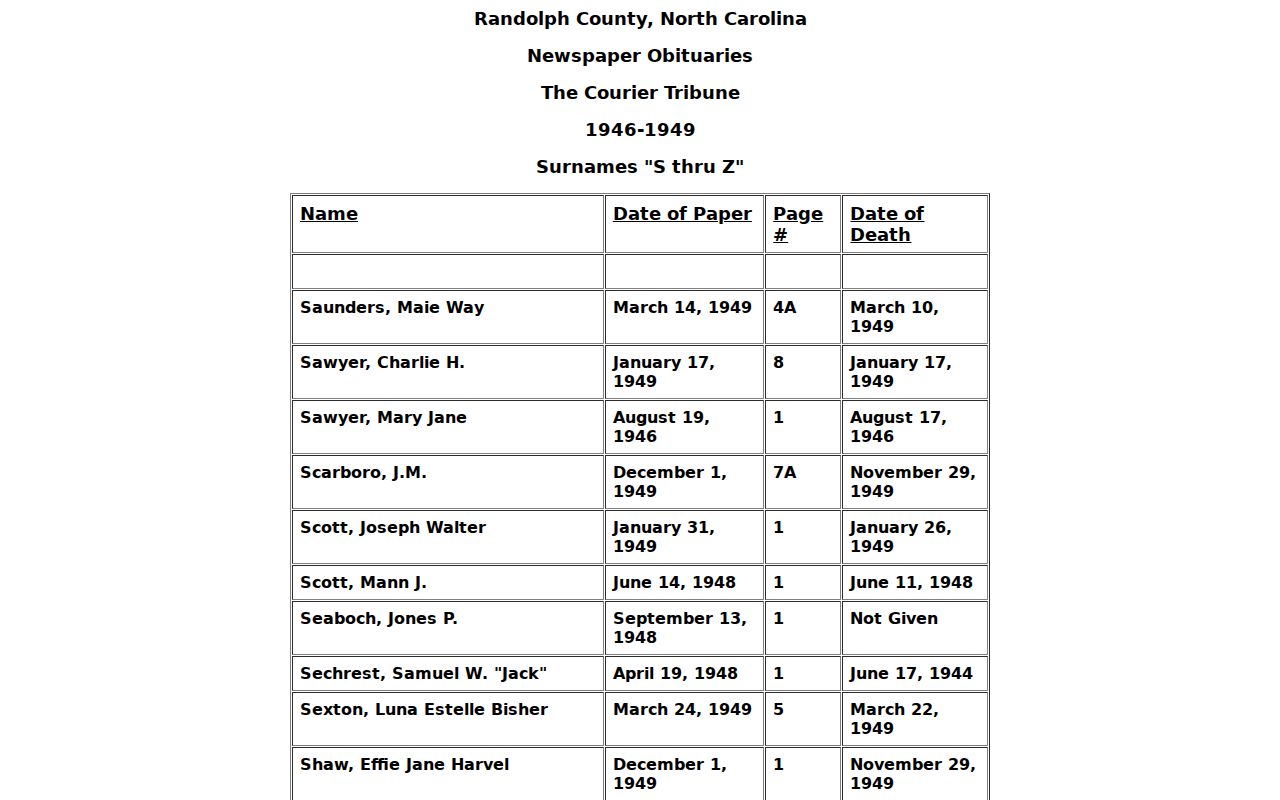
Newspaper evidence can mention former addresses or relatives, but it should be dated and checked against the appropriate official record.
Asheboro Newspaper History Sources
The North Carolina State Archives newspaper guide identifies local title and reel holdings, including the Asheboro Courier, Randolph Tribune, Randolph Guide, Randolph Regulator, Southern Citizen, and Randolph Hub. Coverage is fragmented by title and date. It is not a claim that every issue or notice is online. The paper date can also differ from the event date, so retain both when building a timeline.

Pair a newspaper reference with a directory, census, deed, or probate record rather than using one notice as a complete account of an address.
Asheboro Previous Residents Limits
The trail can end at a coverage gap, a protected record, or an address change that no source explains. Central Permitting has an online workflow for development records, but exact historical public fields and search span were not located. When a specific existing county record may help, a focused North Carolina Public Records Act request can name the parcel, REID/PIN, address, date range, and record type. The agency need not create a new report.
Protect the distinction between a legal party, a taxpayer, and a past household. Do not combine mailing addresses, family references, or nearby records into a profile. A date on a deed records a transaction, not an occupancy date. Keep restricted material closed and ask the custodian about an apparent error instead of publishing an uncertain match.
Lawful use. Use Asheboro house-history research for personal, lawful Asheboro family or property history. Do not use a past address trail to track, harass, intimidate, or harm any living person.