
Asheboro Directory Holdings
The historical shelf is selective, not a year-by-year run. Miller's directories issued by Chas. W. Miller and Southern Directory Co. survive for several Asheboro and Asheboro/Randolph years. DigitalNC provides scans for eight checked issues, while the Randolph Room has a locally confirmed 1941/42 volume. That distinction matters: an absent year online does not mean it was never printed, and a gap between issues should not be treated as a household move.
| Collection | Years | Where Held | Access |
|---|---|---|---|
| Miller's Asheboro directory | 1937/38 | Asheboro DigitalNC and Randolph Room | Digitized record and local copy |
| Miller's Asheboro directory | 1939/40, 1941/42 | Asheboro DigitalNC; Randolph Room | 1939/40 online; 1941/42 locally confirmed |
| Miller's Asheboro/Randolph | 1947/48, 1949/50 | Asheboro DigitalNC/UNC collection | Digitized records and scans |
| Miller's Asheboro/Randolph | 1951/52, 1955/56, 1960, 1962 | Asheboro DigitalNC/UNC collection | Digitized records and scans |
The DigitalNC record for the 1937/38 Miller's volume is a practical first stop when a surname is known.
It establishes a checked volume, while the table preserves the important fact that the available issues are selected rather than continuous.
For the local shelf, the Asheboro Public Library and Randolph Room lists History and Genealogy contact 336-318-6815. Hours are Monday through Friday 9:30 to 12:30 and 1:30 to 5:30, plus Saturday 9:30 to 12:30. A focused question can also go through Ask a Librarian, which gives building patrons priority and aims to respond within 48 hours.
For Asheboro research, compare an Asheboro name, an Asheboro address, and the Asheboro volume date before connecting a household.
Note: Library research help works best for a specific volume or surname, because a request to find everyone with a name is too broad.
Digital Asheboro Directory Runs
DigitalNC is the principal online shelf for the checked Miller's issues. The 1937/38, 1939/40, 1947/48, 1949/50, 1951/52, 1955/56, 1960, and 1962 records support a name-first search followed by a careful page review. The North Carolina Historic Preservation Office separately confirms 1937/38, 1939/40, and 1941/42 at the library's local-history room. The 1941/42 issue is therefore a real bridge in the sequence even though a DigitalNC image was not located.
Open the 1939/40 DigitalNC directory when an address must be checked against a name. The scan includes a street section that can be read in reverse, from street and house number to the listed occupant.
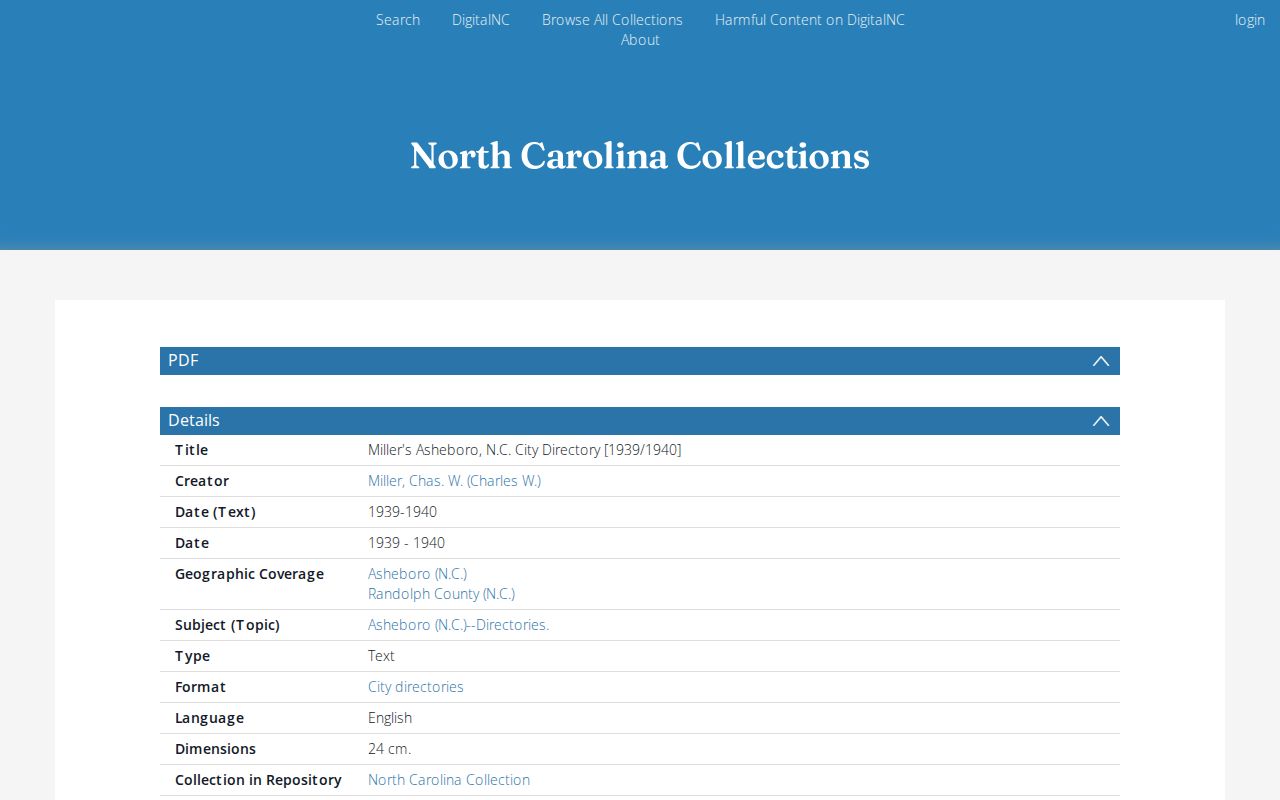
Use the original scan as the evidence source; a text mirror may help find a page, but it should not replace the digitized volume when a detail is recorded.
The Historic Preservation Office survey supports a search at the Randolph Room rather than an assumption that the internet has every issue. The library also lists Ancestry Library Edition inside Randolph libraries and HeritageQuest remotely with a library card, alongside DigitalNC and other local-history material.
Asheboro searchers should keep the Asheboro issue date with each Asheboro transcription and label an Asheboro gap as unlocated.
Read Asheboro Directory Entries
An entry often compresses a household into one line. Start by transcribing what is actually printed. A name can include a spouse or household relationship in parentheses. An occupation or organization role may appear next. The street address, owner or renter indication, and widow notation can all help distinguish similar names, but the meaning depends on the edition. A classified listing is not the same evidence as a residential household listing.
| Name | Alphabetical person or organization heading, sometimes with a spouse or household reference. |
|---|---|
| Occupation | A role, trade, or organization connection, and sometimes an employer or business name. |
| Address | A house number and street, or a shortened residence notation. |
| Household mark | Owner, renter, or widow information only when that edition prints it. |
| Classified listing | A category entry that may identify an organization and address rather than a household. |
- Criss-cross directory
- A street-order section that lets an address lead back to a listed occupant or organization.
- Householder index
- An arrangement intended to identify the household connected to an address, rather than proof of who lived there.
- Abbreviation key
- The edition's decoding list. The 1951/52 volume includes acct for accountant, agt for agent, av for avenue, bkpr for bookkeeper, h for house, r for residence, and mgr for manager.
The 1947/48 directory record on DigitalNC shows the kind of period publication that should be read as a source in its own right.
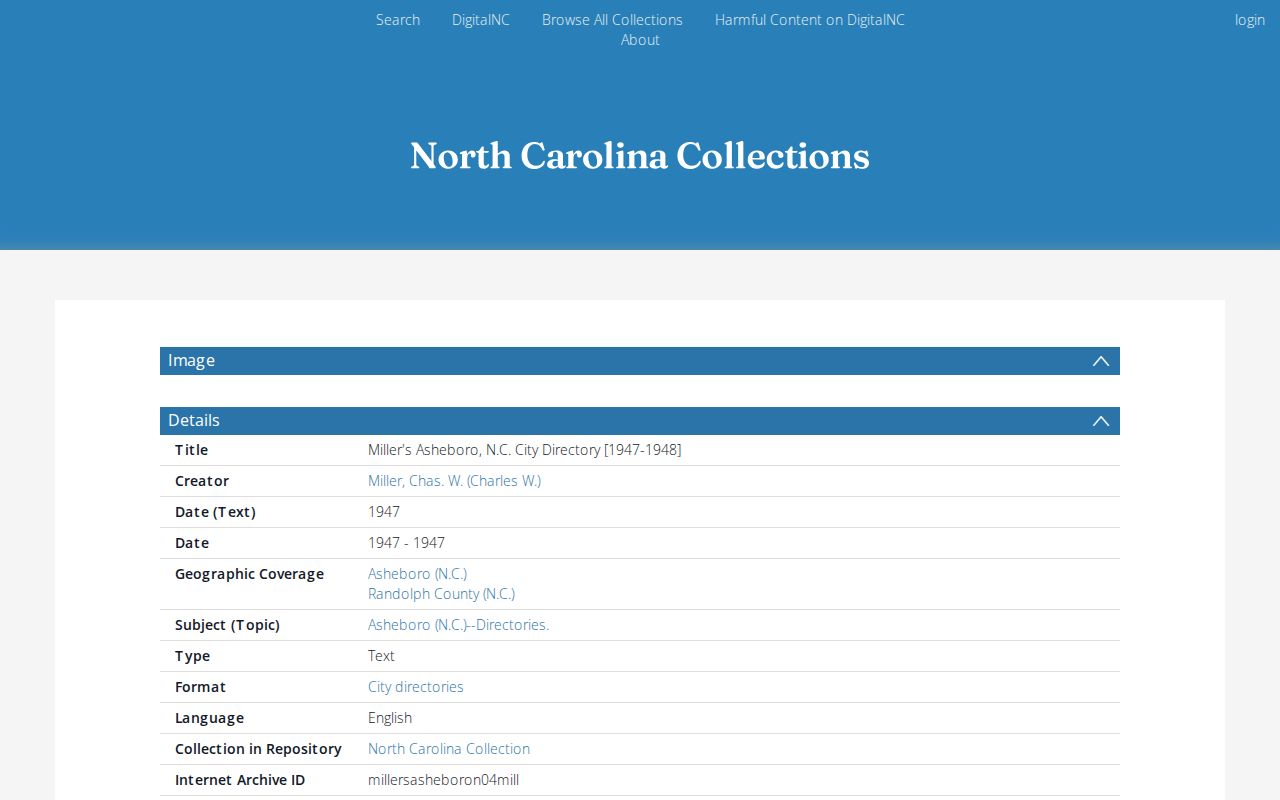
Photograph or note the abbreviation key before interpreting a line, because conventions can change between volumes.
In Asheboro, an Asheboro line should be copied as printed; an Asheboro surname or Asheboro address may differ in a second source.
Reverse Asheboro Directory Addresses
The 1939/40 street section makes an address-first method possible. Begin with the street name and house number, capture the occupant shown there, then turn to the alphabetical entry to compare spelling, relationship, role, and residence notation. The research specifically identifies Carolina Avenue and South Cherry Street among the scanned street entries. That is a useful local method when a family story starts with a house rather than a name.
Old listings need a second check. A street section can show who was printed at the address in that edition, not a legal owner and not every person under the roof. For a current parcel-based address trail, use the separate Asheboro street directory rather than stretching an old volume into a modern record.
An Asheboro address appears only in the context of its Asheboro volume. A later Asheboro parcel record belongs to a different Asheboro timeframe.
Note: A change in house number or street spelling can break an address search, so retain the wording exactly as it appears in the source.
Asheboro Directory Timeline
The available sequence has enough landmarks to structure a search without inventing a publication history. It begins with Miller's 1937/38 volume, moves through the locally confirmed 1941/42 issue, and continues in selected postwar records through 1962. The 1955/56 preface describes Asheboro's 1950 census population as 7,701 and says growth had moved beyond city limits. That is period context, not a current population measure.
- 1937/38: first verified digitized Miller's Asheboro volume.
- 1939/40: digitized issue with the reverse street section.
- 1941/42: confirmed in the Randolph Room by the HPO survey, with no located DigitalNC image.
- 1947/48 to 1962: selected postwar records include 1949/50, 1951/52, 1955/56, 1960, and 1962.
The 1955/56 Miller's record supplies one later comparison point.
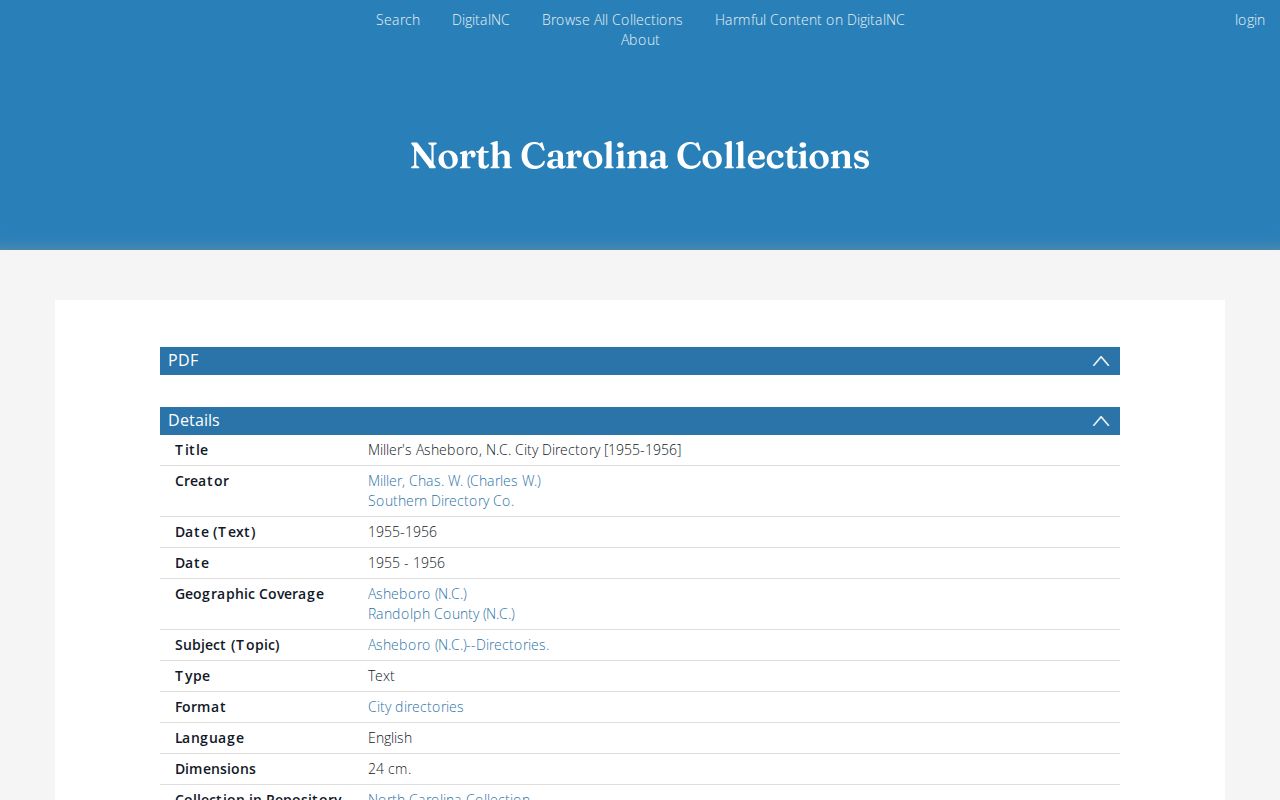
Spacing between available editions is why a disappearance should prompt a census, newspaper, or deed check rather than a quick conclusion.
The Asheboro sequence helps compare Asheboro prewar and postwar entries, but no Asheboro issue fills an unverified interval.
Trace Asheboro Directory Households
Household tracing works best as a dated chain. Use one volume as an anchor, keep every spelling and abbreviation, and compare the next available issue instead of filling a missing year with a guess. The strongest pairings are 1937/38 or 1939/40 with the 1940 federal census, then 1950/51/52-era material with the 1950 census. Census schedules and directories answer different questions, so agreement strengthens a lead while a difference creates a research task.
- Find the name or address in one checked volume and transcribe all listed details.
- Check the same address and surname in the next available issue, including alternate spellings.
- Use the reverse street section to test the address-to-occupant connection.
- Pair the dated listing with the nearest released census schedule and note conflicts.
- Use an obituary index to locate the newspaper issue, then test probate or deed records when the trail requires it.
The Courier-Tribune obituary index supplies a name, paper date, page, and death date for a sample 1946 to 1949 run. Randolph Room microfilm or scans are the next step for the full notice. A directory disappearance may reflect a move, death, changed listing practice, or an unlocated issue.
An Asheboro household should be compared to an Asheboro census schedule and an Asheboro obituary pointer. Record the Asheboro edition that supplied each detail.
Asheboro Directory Map Clues
The Randolph Room's supporting material helps place an address in time. Its genealogy-resources list includes surname files, cemetery surveys, church histories, local scrapbooks, and Asheboro Sanborn editions for 1910, 1922, 1931, and 1950. A Sanborn sheet can place a building footprint or use near the directory date. It does not identify a household by itself, so keep the map and listing as separate evidence.
The Randolph Room genealogy-resources guide identifies those holdings. For newspapers beyond the library index, the State Archives newspaper guide lists fragments of the Asheboro Courier, Randolph Guide, Randolph Tribune, Southern Citizen, and other titles. A paper date and the date of an event can differ, so record both when printed.
For Asheboro map work, keep the Asheboro sheet date beside the Asheboro directory date. An Asheboro street label needs its Asheboro historical form.
Note: A Sanborn map supports a time-and-place comparison, while the directory and newspaper supply separate person or household evidence.
Asheboro Directory Name Variants
Historical labels can decide whether a search succeeds. Older records may use Asheborough or Ashboro before postal standardization as Asheboro on January 10, 1923. Local architectural history also identifies McCulloh Street as the older deed name for Main Street. Try historical city spellings and both street names in directory OCR, deed indexes, and newspapers. The original 1796 plat around the courthouse square supplies the deeper setting for those older labels.
Local architectural-history material documents the McCulloh Street connection. The FamilySearch North Carolina county-records collection is a companion source for Randolph materials, though images can require a free account or an affiliate center. Treat every result as a lead to compare with the dated printed listing.
The Asheboro variants remain useful when an Asheboro result is absent. Use the Asheboro spelling in the Asheboro source, then compare it to an Asheboro index.
Keep an Asheboro worksheet with the Asheboro variant, Asheboro directory year, Asheboro page, Asheboro street form, Asheboro address, Asheboro household, Asheboro source, Asheboro map, Asheboro census, Asheboro obituary, Asheboro library note, and Asheboro date.